Building Something
That Lasts
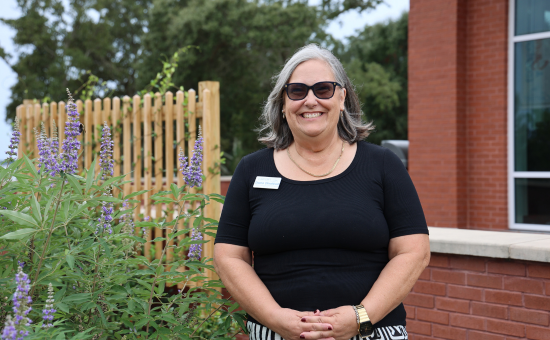
Shana Olmstead: Building Something That Lasts
For Dean Shana Olmstead, education was never part of the plan. It became the purpose—and nearly two decades later, she is helping build a future at Carteret where classrooms, kitchens, gardens, careers, and community all grow together.
There are moments in life that divide everything into before and after.
For Shana Olmstead, that moment lasted about two hours.
It was 2007. Olmstead, who holds a master’s degree from Johnson & Wales University, had been asked to teach hospitality as an adjunct instructor at Carteret Community College. She walked into her first class, taught the lesson, gathered her things and headed to her car.
Then she sat there.
“Really, God?” she remembers thinking. “You waited until now to tell me what I’m supposed to be doing with my life?”
She laughs telling the story now, but the realization was real.
“That was it.”
What began as one class became a career. Adjunct instructor became full-time faculty. Faculty became department chair. Her leadership responsibilities expanded across culinary arts and hospitality. Eventually, horticulture joined the division as well. Today, Olmstead serves as Dean of HCAC and Horticulture at Carteret.
None of it, she will tell you, was part of the original plan.
And yet, somehow, it feels as though she had been preparing for it all along.
“I can’t imagine doing anything else.”
An Education You Can Touch
Long before Olmstead imagined herself as an educator, she believed deeply in the kind of education community colleges provide.
At Johnson & Wales, she experienced an education rooted in application. Students were not simply sitting in classrooms discussing theories. They were in laboratories. They were working with the public. They were being placed in real-world situations where what they knew had to become something they could actually do.
She was fascinated by it.
So fascinated, in fact, that her graduate thesis explored the economic impact of skill-based education compared with more traditional educational models.
Years later, she finds herself helping lead the very kind of education she once studied.
“I have been a believer in this for so long,” she said. “To actually have it come full circle, and now I’m part of that process, is just wonderful.”
Spend a few minutes listening to Olmstead talk about Carteret’s programs and one thing becomes clear: she does not view education as something confined to a syllabus.
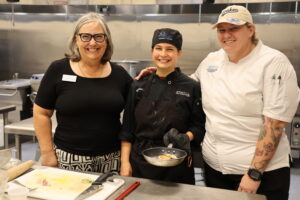 She sees it in motion.
It is a culinary student executing a classical menu.
It is a baking and pastry student producing work for an actual guest.
It is a hospitality student learning what service feels like when the dining room is full.
It is a horticulture student designing and creating a space.
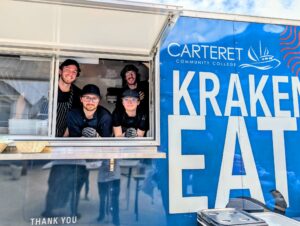
It is a student taking responsibility for a food truck.
It is a student leaving Carteret not only with a credential, but with experiences they can point to when an employer asks, What can you do?
“We’re creating résumés,” Olmstead said. “It’s not just an education.”
That distinction matters to her.
The Escoffier Dinner Series, food truck experiences, public events, competitions and hands-on labs are not extras added around the curriculum. In Olmstead’s vision, they are part of the curriculum because each experience gives a student another story to tell an employer.
Another skill to demonstrate.
Another reason to believe they are ready.
“We Do This Together. All the Time.”
There is one phrase that surfaces repeatedly when Olmstead talks about her division:
We do this together.
It is more than a slogan.
It is one of her leadership principles.
When horticulture became part of her area, one of Olmstead’s first questions was how programs that might appear very different on paper could function as one division.
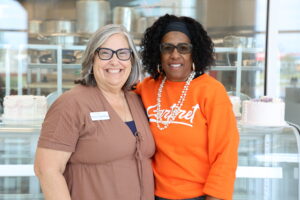 Her answer was integration.
Today, her area encompasses multiple curricula, but she does not want them operating as separate islands.
“There is no ‘our students’ and ‘their students,’” she said. “It’s everybody’s students.”
For Olmstead, that expectation is non-negotiable.
A faculty member may teach primarily in one program, but the success of the entire division still belongs to everyone. When one area hosts a major event, others show up. When students need support, people step outside the boundaries of their own programs.
“We all do this together,” she said. “All the time.”
But collaboration, in Olmstead’s view, also means recognizing the individual people who make that success possible.
She is intentional about giving credit.
When a faculty member grows, excels or takes ownership of something important, Olmstead wants that work noticed. She spoke proudly, for example, about Chef Wert and the growth she has witnessed in her work.
“I want to make sure credit goes where the credit needs to go,” Olmstead said. “I want to make sure that is noticed and that she gets more and more responsibility because she deserves that growth path.”
That combination—high expectations paired with a genuine desire to see other people succeed—reveals much about how Olmstead leads.
The goal is not to build something around herself.
It is to build something people feel ownership of together.
From an Old Golden Corral to Something Extraordinary
Perhaps no story captures the evolution of Carteret’s culinary programs better than the building where they began.
Olmstead remembers the early days well.
The program was operating from a former Golden Corral restaurant.
“When it rained, it rained into the building,” she said.
She smiles at the memory because despite the limitations, the work happening inside was good.
“We were great. We had great programs, and we worked really hard.”
Then came a bigger vision.
Former Carteret President Dr. Kerry Youngblood recognized the need for a dedicated culinary facility, and the College began working toward making it possible. Olmstead remembers campaigning for the bond, talking with the community and helping people understand why a strong culinary school made sense in a region so deeply connected to tourism, hospitality and food.
They “hit the bricks and the pavement,” as she describes it.
Eventually, the vision became real.
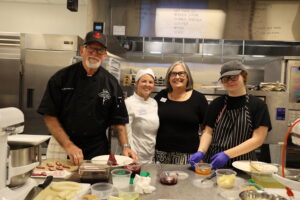 Today, students learn inside a modern facility with expansive laboratory space that would have been difficult to imagine during those rainy days in the former restaurant.
Olmstead still has moments when she looks around and cannot quite believe how far the program has come.
“We still feel like we’re playing dress-up in our mother’s closet because we can’t believe that it’s all ours,” she said.
Then something else happened.
Students came.
And kept coming.
“If you build it, they will come,” Olmstead said. “That is absolutely the case.”
Programs have experienced waiting lists. Carteret’s reputation has continued to grow across North Carolina. Students participate in SkillsUSA competitions, and Carteret now hosts state-level culinary, baking and pastry, and restaurant service competitions for high school and postsecondary students.
Local employers participate as advisors and competition judges. They see student talent firsthand. More importantly, they help Carteret understand what skills graduates need when they walk into the workplace.
“We really don’t make decisions without talking to our employers because it makes no sense,” Olmstead said. “Our job is to make sure that our students have jobs.”
For her, employer involvement is not ceremonial.
It is essential.
Growing Possibility
Ask Olmstead what comes next and her entire energy shifts.
You can almost see the future she is describing.
Outside the Hospitality & Culinary Arts Center, she envisions an orchard.
Nearby, a pollinator garden filled with flowers.
There will be vegetables, herbs and other ingredients growing steps away from the kitchens where students will eventually prepare them.
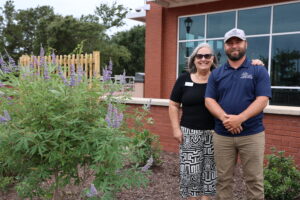 There are plans for bees and honey.
A hydroponic greenhouse could produce lettuce, tomatoes and cucumbers.
And perhaps, eventually, chickens—although Olmstead is quick to point out that adding animals means first making certain the College can care for them properly.
This is Carteret’s developing farm-to-table vision, and for Olmstead, it represents much more than fresh ingredients.
It is where horticulture and culinary education finally become one continuous lesson.
A student will be able to understand where food begins—not on a delivery truck or a grocery store shelf, but in soil.
Culinary and baking students will participate in growing.
Horticulture students will have opportunities to enter the kitchen and learn what happens to the fruits, vegetables and herbs they cultivate.
“We have to teach that concept about taking things from the ground and moving it into the kitchen,” Olmstead said.
She also sees the project extending beyond the College.
Olmstead wants farm-to-table education to become community outreach, with the potential to help students and community members have greater access to fresh fruits and vegetables.
As Olmstead shares the vision, each piece comes together into something much larger—a living, hands-on learning environment where education, sustainability and community are deeply connected.
Students moving between garden and kitchen.
Fresh produce becoming ingredients.
Horticulture and culinary students learning side by side.
The community becoming part of the experience.
For Olmstead, that is the point.
Integration becomes education.
And education becomes impact.
Creating a Place for More Students
For Olmstead, creating opportunity also means making sure more students have a pathway to discover their abilities, develop meaningful skills and envision a future for themselves.
Through Food Service Technology and Landscaping Service Technology, Carteret works with local high school students with intellectual and developmental disabilities who are participating in occupational and life-skills pathways.
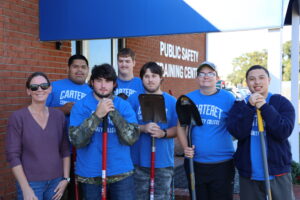 Students come to Carteret from area high schools and work directly with College faculty. They develop job skills, earn college credentials and have the opportunity to participate in Carteret’s graduation ceremony.
Some may earn their college credential before receiving their high school credential.
“We have created a pathway, with the support and collaboration of our public school system, to make sure these students will have a choice and will be able to get jobs,” Olmstead said.
That word—choice—carries weight.
Because underneath the kitchens, gardens, credentials and competitions, Olmstead’s philosophy keeps returning to the same idea.
Opportunity should lead somewhere.
A student should leave with possibilities.
Creativity With a Career Attached
Culinary arts. Baking and pastry arts. Horticulture.
To someone standing outside those industries, they may seem like very different career paths.
Olmstead sees the common thread immediately.
Art.
“We call it culinary arts. We call it baking and pastry arts,” she said. “I think in some ways we should call it horticulture arts.”
Each requires an eye for design.
Color matters.
Composition matters.
Creativity matters.
Whether someone is plating a dish, decorating a pastry or designing a landscape, they are taking individual components and creating an experience from them.
There is also another quality connecting the programs: entrepreneurship.
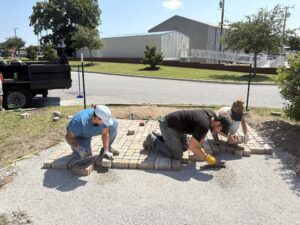 A graduate could someday operate a food truck, launch a bakery or build a landscaping company.
“What we do is entrepreneurial in spirit,” Olmstead said. “We’re helping you create a pathway where you could own your own food truck. You can own your own landscaping design business. You can own your own bakery.”
She is equally candid about the work required.
“These are not easy jobs,” she said.
They demand stamina.
They demand discipline.
They require people willing to work hard and work as part of a team.
But for the right person?
“Oh my gosh,” Olmstead said. “You get to work with amazing teams. You get to create food all day or create landscaping all day. It’s wonderful.”
And, she adds with a laugh, in culinary arts there is another benefit.
“You get to eat the fruits of your labor.”
The Woman Behind the Dean’s Office
The title “Dean of HCAC and Horticulture” may suggest someone who spends her free time effortlessly preparing elaborate meals before heading outside to tend a flawless garden.
Olmstead would like to clear that up immediately.
Absolutely not.
“I’m very good at administration,” she said, laughing.
She considers herself a good home cook—her Italian sauce and gravy receive particularly high marks—but she makes no claim to cooking at the level of Carteret’s professional culinary faculty.
As for gardening?
“I kill my plants on a regular basis.”
Her horticulture students, naturally, find this hilarious.
She has managed to keep succulents alive.
Mostly.
Given the choice between spending a free afternoon in the kitchen or garden, Olmstead chooses option three.
She would rather be behind a bar creating cocktails.
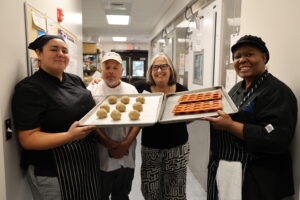 Her affection for hospitality goes back to her first job, waiting tables in the dining room of a country club.
There, in a formal service environment, she discovered that she loved interacting with people.
“I like this,” she remembers thinking.
The job taught her the nuances of formal table service and hospitality—skills she would later use while training employees, opening her own restaurant and, eventually, teaching students.
Outside Carteret, life has entered a new season.
Originally from Orange County, New York, Olmstead has lived in Carteret County for 28 years—the same number of years she has been married to her husband, Chef Floyd.
Why did she stay?
“That’s why I stayed,” she said with a smile.
Her husband is a chef. Their daughter is now in graduate school, leaving Olmstead an empty nester who has discovered a new obsession: Mahjong.
She spends time with a close group of friends, travels and goes to concerts.
 And long before becoming Dean Olmstead, she had another adventurous side.
Until around age 35, she sailed and raced 16-foot Hobie Cats, first learning on Long Island Sound and later sailing in the ocean after moving to North Carolina.
The woman who admits computer programs can intimidate her was apparently perfectly comfortable racing a small catamaran across open water.
That contrast feels fitting.
Laughing Through the Mistakes
Olmstead is comfortable admitting something else.
She makes mistakes.
A lot of them, according to her.
Not because she is careless, but because she tries things.
“I try everything,” she said.
Over time, she has learned not simply to accept those mistakes but to laugh at herself when they happen.
That ability has quietly become part of her leadership style.
When the person at the top can say, I messed that up, laugh and move forward, everyone else gets permission to do the same.
“What that does is make other people comfortable with coming and saying, ‘I’ve made a mistake,’” Olmstead said. “And they can start laughing at themselves as well.”
There is something revealing in that philosophy.
The programs Olmstead oversees are built on hands-on learning.
Hands-on learning requires trying.
Trying occasionally means failing.
And growth requires being willing to return the next day and try again.
Perhaps that is one reason her leadership feels so connected to the programs themselves.
Both are grounded in doing the work.
Building a Legacy in Real Time
Near the end of the interview, Olmstead was reminded that the growth surrounding her represents something bigger than a collection of programs.
It is a legacy.
Not one she is leaving behind anytime soon.
One she is still actively building.
You can see it in the journey from a leaking former restaurant to a thriving Hospitality & Culinary Arts Center.
You can see it in students competing statewide.
In graduates entering the workforce.
In high school students earning college credentials.
In faculty members growing into leadership.
In employers helping shape curriculum.
And soon, perhaps, in an orchard outside the building, bees moving between flowers and students harvesting ingredients they will carry inside and transform.
Olmstead did not plan to become an educator.
Maybe that is part of what makes her story compelling.
She found the work that made sense of everything that came before it.
The young woman who studied skill-based education became the instructor who taught it.
 The instructor became the leader who expanded it.
And the leader is now imagining what it might become next.
Through every stage, the philosophy has remained remarkably consistent:
Give students experiences that mean something.
Give people room to grow.
Connect education to work.
Connect the College to its community.
And never build alone.
“We do this together,” Olmstead said.
“All the time.”
And if you have spent any time around the Hospitality & Culinary Arts Center, you might already know there is another unofficial title floating around for the woman who has watched so much of that transformation happen.
Around there, some simply know her as the Queen.