Building the Future of IT
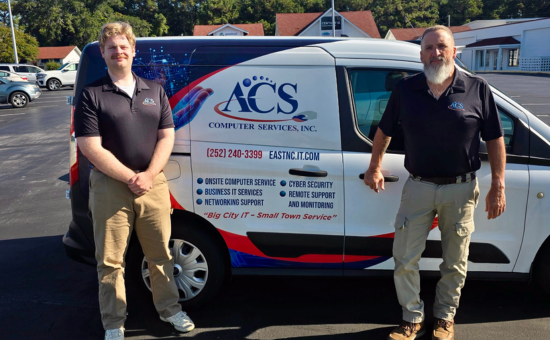
Carteret Works Connects Student Talent with ACS Computer Services
Carteret Community College student and Marine Corps veteran Skyler DeBoer becomes ACS Computer Services’ first apprentice, creating a new pathway from the classroom to a career in information technology.
For Carteret Community College student Skyler DeBoer, building a career in information technology has never been limited to what can be learned inside a classroom. It has been shaped by military service, hands-on experience, a commitment to continued learning and now, a new opportunity to put those skills to work in the local community.
DeBoer, an Information Systems Associate in Applied Science student at Carteret and a veteran of the United States Marine Corps, has been selected as the first apprentice with ACS Computer Services through Carteret Works’ Network and Computer Systems Apprenticeship.
The partnership marks an important milestone for DeBoer, ACS Computer Services and Carteret Community College as they work together to create a direct connection between education and employment in a growing and constantly changing industry.
From Military Service to a New Career Path
DeBoer entered Carteret with an established background in information technology. During his service in the Marine Corps, he worked as a Data Systems Administrator, supporting networks, computer systems and users across a large organization.
That experience sparked a deeper interest in the systems that keep organizations connected and operating.
“I enjoyed troubleshooting problems, determining their underlying causes, and helping people get back to work,” DeBoer said. “Those experiences showed me that IT was not only something I was capable of doing, but also a field in which I could continue learning throughout my career.”
After the military, DeBoer chose Carteret as a practical way to continue developing his technical skills while remaining connected to the community. His Information Systems program has allowed him to build upon his previous experience while expanding his knowledge of networking, computer hardware, operating systems, cybersecurity, databases, virtualization and user support.
His long-term goal is to become a network engineer, with advanced skills in Cisco networking, enterprise wireless systems, network security and Linux and Windows administration.
The apprenticeship with ACS is providing another critical piece of that journey: experience working with real customers, businesses and technology environments.
A Partnership Built Around Workforce Needs
For ACS Computer Services President Stefan Hellersperk, the apprenticeship provides an opportunity to develop talent from the beginning while addressing one of the challenges many employers face: finding qualified, dependable employees.
Founded in 1997 as a traditional computer repair shop, ACS Computer Services has grown into a business-focused IT provider supporting clients throughout Carteret, Craven and Onslow counties. In recent years, the company has placed an increased emphasis on cybersecurity as email, computer and network security have become increasingly important for businesses.
“It’s always challenging to find qualified or responsible employees,” Hellersperk said. “This seemed like a good way to be able to mold a technician from the beginning with the proper ethic and knowledge to start their career, while filling open spots.”
That employer-driven approach is at the heart of Carteret Works’ apprenticeship model.
According to Carteret Works Director Sharon King, employer involvement is essential because local businesses understand firsthand the skills, positions and workforce challenges facing their industries.
“Registered Apprenticeship is employer-led,” King said. “Employers help us create career pathways that connect Carteret programs directly to local workforce needs.”
Rather than waiting until a position becomes vacant, apprenticeship gives employers an opportunity to build their future workforce intentionally. Businesses can connect with potential employees while they are still completing their education and help develop their skills around the organization’s specific needs and expectations.
For ACS, that means giving DeBoer exposure to an environment that changes from customer to customer and often from one day to the next.
Turning Classroom Knowledge into Real-World Experience
ACS supports a wide range of clients, from individual home users to businesses operating across multiple counties and states. An apprentice may assist walk-in customers or incoming calls one day and travel to a client location to address an urgent technical problem the next.
That variety is exactly what makes the experience valuable.
“We have a broad spectrum of systems that we deal with across our customer base,” Hellersperk said. “Just about every day there will be new issues to deal with, different personality types to adjust to and many different types of common equipment to learn about.”
For DeBoer, that variety provides an opportunity to strengthen both his technical knowledge and his ability to solve problems in situations that cannot always be recreated in a classroom.
“The biggest difference is that real-world problems are rarely presented as neatly as classroom exercises,” DeBoer said. “In a professional environment, a customer may describe a problem in very general terms, and the technician must determine what is actually happening.”
The work requires more than simply understanding technology. Technicians must consider a customer’s time, technical knowledge, business operations, data and budget while communicating clearly and determining the best solution.
That combination of technical and interpersonal experience is an important part of what Hellersperk hopes an apprentice gains from the program.
“You can read about IT, but most of it does not start making sense and coming into focus until you do it,” he said. “Real-world experience in working systems with the high stress of tight timelines when entire networks are down is experience that cannot be taught.”
Support From Start to Finish
Behind the apprenticeship is Carteret Works, which serves as the primary point of contact for both the employer and apprentice throughout the process.
For employers, Carteret Works manages the paperwork required to establish and register an apprenticeship with ApprenticeshipNC, helps customize occupational competencies around the employer’s needs, coordinates documentation and can help identify and pre-screen potential candidates.
For students, the support extends beyond securing the position. Carteret Works can provide individualized career assistance, resume and cover letter support, employment preparation and connections to resources that may help address barriers such as transportation, tuition and textbooks.
Once an apprentice is hired, that support continues.
Carteret Works works alongside the employer and apprentice to monitor progress, track required competencies, coordinate documentation and help address challenges throughout the program. Upon successful completion, the apprentice earns the appropriate State of North Carolina apprenticeship credentials.
“Ultimately, Carteret Works takes much of the administrative burden off the employer while providing the apprentice with the support needed to successfully complete the program,” King said.
A Shared Understanding
For DeBoer and Hellersperk, the partnership also includes a connection that goes beyond technology: both are Marines.
Hellersperk understands firsthand that transitioning from military service into civilian employment can come with challenges.
“Having him as our first apprentice was pretty convenient,” Hellersperk said. “I have been able to recognize when the two are colliding and provide advice on how to deal with them.”
He also recognized qualities in DeBoer’s military background that translate directly into the workplace, including attention to detail, accountability and timeliness.
DeBoer has similarly found that the experience and discipline he developed during his military career have provided a foundation for his next chapter.
Being ACS Computer Services’ first apprentice is an opportunity he does not take lightly.
“Being the first apprentice means I have an opportunity to help establish a pathway for other Carteret students,” DeBoer said. “I want my work to demonstrate that apprenticeships can benefit the student, the employer, the College and the local community.”
Investing in Carteret County’s Future Workforce
While the partnership between ACS Computer Services and Carteret Works is still new, Hellersperk sees potential for apprenticeship to become another valuable way for employers to connect with people who are genuinely interested in joining their industries.
“If this continues as it has so far, I can see this as a good pool of people that are interested in working in our field,” he said.
For King, partnerships like this one represent a larger investment in Carteret County.
When local employers actively participate in workforce development, students can see clearer pathways between their education and careers available close to home. Employers gain opportunities to develop talent around their needs, and the community is better positioned to retain skilled workers.
“Planning for the future workforce, not just hiring to fill today’s immediate vacancies, is critical to an employer’s long-term success,” King said. “When employers are actively involved in workforce development, we can create stronger pathways from education to employment, retain more local talent and build a workforce that supports the continued economic success of Carteret County.”
For DeBoer, the pathway has already begun.
From serving as a Data Systems Administrator in the Marine Corps to studying Information Systems at Carteret and becoming ACS Computer Services’ first apprentice, each experience has built upon the one before it.
“My journey demonstrates that education and professional experience do not have to exist separately,” DeBoer said. “The apprenticeship with ACS Computer Services represents the next step in that process.”
And as that first apprenticeship grows, it has the potential to become something more than one student’s career opportunity. It can become a model for how Carteret Community College, Carteret Works and local employers work together to prepare talent, strengthen businesses and build the workforce Carteret County needs for the future.
For more information about our Apprenticeship program visit info.carteret.edu/carteretworks